Airbnb co-host fees: what managers charge in Belgium and the Netherlands, and what’s left
What managers in Belgium and the Netherlands say they charge, what the percentage is calculated on, how co-hosts get paid, and a worked euro example of what the owner and the co-host each keep.
Sources listed, last checked
General information, not legal or tax advice. Rules differ by country and city and change often, so check the official source and ask a qualified adviser before you act.
Managers who publish their prices put full short-term rental management at roughly 15% to 40% of rental revenue. BnB Assist, a Belgian management company, wrote in 2024 that most commission-based managers ask 20 to 40% of the booking amount, and BetterStays, a Dutch booking management company, put the usual commission at 15 to 30% of gross rental income in August 2026.78 The percentage is only half the answer. What it is calculated on, what is billed on top, and Airbnb’s 15.5% fee plus VAT move the euros the owner and you each keep as much as the rate does.13
Key takeaways
- Published commission figures from managers run from about 15% to 40%, and each company measures it on a different base.78
- The base matters as much as the rate: in this guide’s example, the same 20% is worth €328 to €490 a month depending on what it is taken from.
- Airbnb’s single fee is 15.5% for most hosts, charged on the nightly price and the cleaning fee, and a host who is not VAT-registered in Belgium or the Netherlands also pays 21% VAT on it.123
- Airbnb can split the payout for you, calculated on the host’s earnings after its fee, or you can invoice the owner yourself.4
- VAT on your commission is a separate question from VAT on the accommodation: small business exemptions stop at €25,000 in Belgium and €20,000 in the Netherlands.1113
In this guide
- What managers charge in Belgium and the Netherlands
- Four ways to charge
- The commission base changes everything
- The 15.5% host-only fee, in short
- How co-hosts get paid
- VAT and invoicing your commission
- A worked example: one unit, one month
- What a co-host earns per month
- How to set your own fee
- Questions people ask
- Sources
If you are the owner, read four guides in this order: this one on what managers charge, then a revenue projection you can check, the clauses to discuss before you sign an agreement and what damage cover and insurance do.
What managers charge in Belgium and the Netherlands
No regulator publishes a rate, and we found no independent Belgian or Dutch study. The figures below come from companies that sell management or advise owners, so read them as the trade describing itself, not as a survey.
Published commission figures for short-term rental management
| Source | Market | Figure | Calculated on | Date |
|---|---|---|---|---|
| BnB Assist, Belgian manager7 | Belgium | 20 to 40% | Booking amount | 2024 |
| BetterStays, Dutch booking manager8 | Netherlands | 15 to 40% overall, usually 15 to 30% | Realised or gross rental income | August 2026 |
| Jedéclaremonmeublé, French accounting service9 | France | 15 to 30%, or a fixed €150 to €400 a month | Gross income | 2026 |
| Rentaplus, French manager10 | France | Quoted 18% can reach more than 30% once extras are added | Rental revenue | June 2026 |
BetterStays says full management sits at the higher end of its range, and both French sources warn that a low headline rate often comes with more charges on the side.8910
What’s usually included, and what’s billed separately
According to BetterStays, the fee usually covers reservations, guest communication, placing the listing on platforms such as Airbnb and Booking.com, and basic reporting.8 It lists these as often charged separately:8
- professional photography and styling advice
- cleaning and linen
- small repairs and maintenance
- dynamic pricing software
- onboarding or set-up costs
Rentaplus shows how extras add up: in its example the guest pays an €80 cleaning fee, the cleaner gets €45 and the manager keeps €35. It also warns that a rate quoted without VAT is higher once VAT is added.10 Extras are fine when agreed in writing; the problem is an owner comparing your 20% with someone else’s 18% without seeing the rest.
Watch out: Never quote a percentage on its own
Give every owner three things together: the rate, the base it is calculated on, and a euro example for one realistic month. Put all three in the management agreement, along with every service you bill separately.
Four ways to charge
Most managers use a percentage, a fixed fee or a mix of both.89 Each model puts the risk of a quiet month on a different side of the table.
Fee models compared
| Model | How it works | Good for the owner | Hard part for you |
|---|---|---|---|
| Percentage | A share of revenue per booking or per month | You only earn when they earn, so interests line up8 | Your income falls in the low season while the work does not stop |
| Fixed monthly fee | The same amount every month, whatever the bookings | Predictable costs8 | BetterStays notes it gives the manager less reason to fill the calendar8; you carry the risk of busy months |
| Percentage plus set-up fee | A one-off fee for photos, listing and setup, then a percentage | Clear price for the start-up work | Owners compare set-up fees hard; say what it pays for |
| Percentage with a monthly minimum | A percentage, but never less than an agreed amount | Low-season service stays funded | Harder to sell to a first owner; be ready to explain the maths |
A minimum suits seasonal units, because a quiet February still needs messages and checks. A plain percentage is usually the easier first offer when you have no track record; see finding your first client.
The commission base changes everything
The commission base is the amount your percentage is taken from. Every step to a narrower base moves money from you to the owner.
- Gross booking value: everything the guest pays for the stay, cleaning fee included. Easiest to check, but it includes money that goes to the cleaner and to Airbnb.
- Accommodation revenue: the nightly revenue without the cleaning fee.
- After platform fees: accommodation revenue minus Airbnb’s fee and VAT on it. This is close to Airbnb’s own payout sharing, which calculates a percentage on the host’s earnings after its host service fee, with the cleaning fee excluded if the owner chooses.4
- Net: what is left after platform fees, VAT, cleaning and agreed costs. It protects the owner most, but every disputed cost becomes a dispute about your fee.
Worked example: The same unit on four bases
A flat at €100 a night, booked for 21 nights in one month in seven stays of three nights, with a €50 cleaning fee per stay that is paid straight to the cleaner. Airbnb’s fee is 15.5% plus 21% VAT on the fee, as for a host who is not VAT-registered in Belgium or the Netherlands.13 Commission is 20% throughout.
| Base | Amount | 20% |
|---|---|---|
| Gross: nights plus cleaning | €2,450.00 | €490.00 |
| Nights only | €2,100.00 | €420.00 |
| Nights after Airbnb fee and VAT | €1,706.14 | €341.23 |
| Net of fees, VAT and cleaning | €1,640.50 | €328.10 |
The same 20% is worth between €328.10 and €490.00. This is an illustration, not a prediction; the full breakdown follows in the worked example further down.
The 15.5% host-only fee, in short
Airbnb is moving hosts to a single host-only fee that comes entirely off the host’s payout: most hosts pay 15.5% and the rest typically 14 to 16%, charged on the nightly price and on fees the host adds, such as the cleaning fee.12 Hosts who live in the European Economic Area or Switzerland have until 13 October 2026 to adjust their prices, and a co-host cannot make that one-time adjustment for the owner.1 The full fee comparison with Booking.com is in Airbnb vs Booking.com for hosts.
For a co-host, the part that matters is VAT. Airbnb charges VAT on its host service fee, at 21% for Belgium and for the Netherlands; a host who is registered for VAT may not be charged it but may have to self-assess it instead.3 For an owner who is not VAT-registered, the fee therefore costs 15.5% plus 21% of that 15.5%, which is 18.755% of the subtotal.13
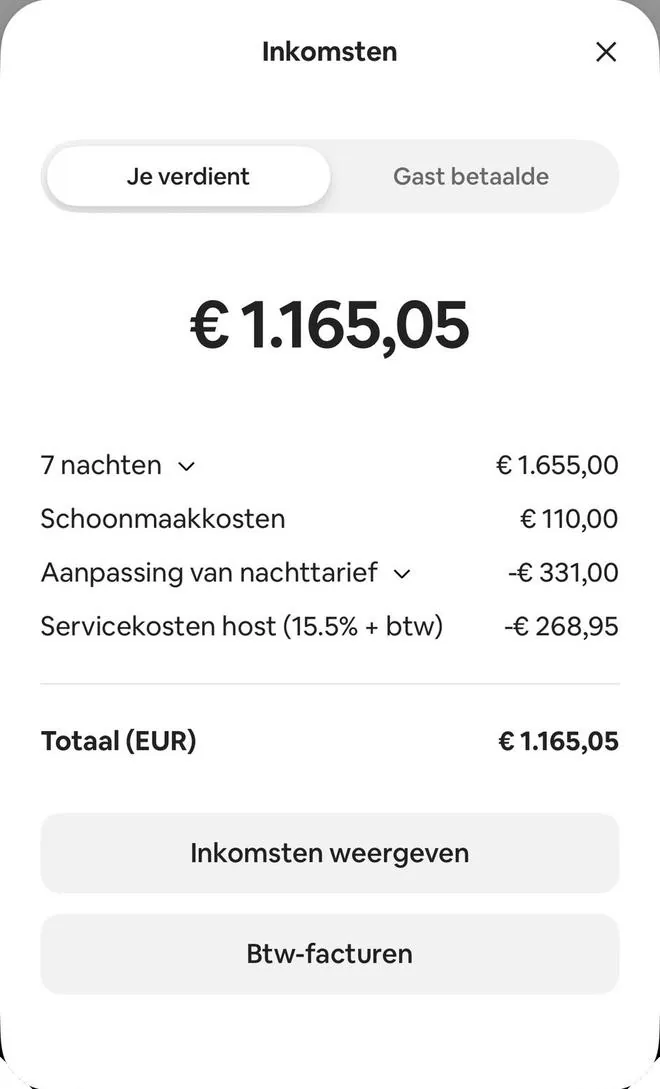
On the screen above, nights plus cleaning minus a rate adjustment leave €1,434.00. The host fee of €268.95 is exactly 18.755% of that, so it was charged on the cleaning fee too, with 21% VAT on top.13 A commission after platform fees starts from the €1,165.05 at the bottom, not from the €1,655 of nights.
How co-hosts get paid
You have two routes: Airbnb splits the payout for you, or you invoice the owner.
Airbnb’s co-host payouts
Only the listing owner can set up a co-host payout, and the co-host then has 14 days to confirm or decline the proposal.4 The owner can choose from four options:4
- Cleaning fee: you receive the cleaning fee set in the listing.
- Cleaning fee plus percentage: the cleaning fee plus a percentage of each booking that excludes the cleaning fee.
- Percentage: a percentage of each booking, with the cleaning fee excluded or included.
- Fixed amount: a set amount per booking.
The percentage is calculated on the host’s potential earnings: nightly price times nights, plus fees such as cleaning, minus the host service fee and any applicable taxes and fees.4 For most stays, host and co-host payouts are sent by the end of the business day after check-in, and when the host’s earnings cover every co-host payout, co-hosts are paid first and the host receives the rest.46
Know the limits before you rely on it:
- Payouts only cover guest stays on Airbnb, not service or experience bookings, damage protection reimbursements or Resolution Center payouts.4
- If a guest cancels, your share is worked out on the host’s reduced earnings. If the host or a full-access co-host cancels after payouts were sent, Airbnb deducts the refund from future payouts, which can leave you with less or nothing.6
- If the host’s earnings on a booking do not cover the co-host payouts set up, you may receive less than agreed or no payout.6
- The owner receives tax documents on the full booking amount, and you receive them for the amounts paid to you.4
- Outside the US and the EU, a host can share payouts with only one co-host per listing, and listings in Mexico are not supported. On 15 September 2026 Airbnb listed no extra limit for hosts in the EU.5 Check the page again before you promise an owner this route.
Invoicing the owner
The alternative is a monthly invoice to the owner. It covers every channel, including Booking.com and direct bookings, and any base you agreed, including a net base that Airbnb’s options do not offer.4 The cost is admin and chasing payment. Send the invoice with the owner report so the numbers behind it are in the same email.
VAT and invoicing your commission
This section is about VAT on your own service. It is separate from VAT on the accommodation, which depends on how the letting itself is taxed and is covered in Airbnb rules in Belgium and the Netherlands. This is general information, not tax advice.
Belgium
A business established in Belgium can opt for the small business exemption if its annual turnover is no more than €25,000 excluding VAT, whatever its legal form.11 Under it you charge no VAT and file no periodic returns, but you still need a VAT number, cannot deduct VAT on costs, and must report the previous year’s turnover by 31 March.11
Watch the edges. If you start during the year, the €25,000 is reduced in proportion to the days already passed.11 If you go over it by no more than 10% you keep the exemption for that year and move to the normal scheme the next year; go over by more than 10% and the normal scheme applies from the transaction that crossed the limit.11 Under the normal scheme, Belgium’s standard VAT rate is 21%.12
The Netherlands
The Dutch small business scheme, the KOR, is open to businesses established in the Netherlands with a turnover of no more than €20,000 per calendar year, and you have to register for it.13 Inside the KOR you charge no VAT, file no VAT returns and cannot reclaim VAT on costs and investments.13 Outside it, the general rate is 21%, and services are taxed unless they fall under the 9% rate, the 0% rate or an exemption.14
What it means for your price
Say whether your commission includes VAT: 20% plus 21% VAT costs an owner who cannot reclaim VAT 24.2% of the base.1214 An owner who is VAT-registered for the letting may be able to deduct it. Ask an accountant which case applies before your first quote, and remember that a few units can take your turnover past either threshold.
A worked example: one unit, one month
The same flat, followed through to what each side keeps. The owner is not VAT-registered, the letting is assumed to carry no VAT, and the co-host takes 20% of accommodation revenue without cleaning.
Worked example: One flat, one month, 20% on accommodation revenue
The inputs: €100 a night, 21 booked nights in seven three-night stays, a €50 cleaning fee per stay paid in full to the cleaner, and Airbnb’s 15.5% host fee plus 21% VAT on that fee.13
| Line | Amount |
|---|---|
| Nights: 21 × €100 | €2,100.00 |
| Cleaning fees: 7 × €50 | €350.00 |
| Gross booking value | €2,450.00 |
| Airbnb host fee, 15.5% of €2,450 | −€379.75 |
| VAT on the fee, 21% of €379.75 | −€79.75 |
| Payout from Airbnb | €1,990.50 |
| Cleaner, 7 turnovers × €50 | −€350.00 |
| Co-host commission, 20% of €2,100 | −€420.00 |
| Owner keeps, before running costs and income tax | €1,220.50 |
The owner still pays utilities, internet, insurance, consumables, any tourist tax not passed to guests, and income tax on what is left. The co-host still pays their own costs and, above the thresholds in the VAT section, adds VAT to the €420.1113 Agree the base on “after platform fees” instead and the commission drops to €341.23, so the owner keeps €1,299.27.
This is an illustration built from round example numbers, not a prediction of what a property or a manager will earn.
To try your own unit, open the revenue calculator with similar numbers filled in, and switch the commission base to see both sides move. Before you show an owner a monthly figure, build it from real comparable listings as explained in how to estimate what a property will earn.
What a co-host earns per month
Your income is the commission from each unit, added up, minus what it costs you to earn it. We found no reliable published average for Belgium or the Netherlands, so distrust any figure without a base and a source.
As an illustration, five flats like the one above bring in €2,100 of commission in a month like that one, before costs, VAT and income tax. A quiet month brings in much less, while the work does not shrink. Before you call it income, take off software, travel for inspections and handovers, liability insurance, backup for when you are away, and the unpaid time spent on onboarding and owner reports.
Growth changes the maths again once you pay others for work you did yourself; see scaling a management business past 10 units.
How to set your own fee
- Check what local managers publish. Note each rate, base and extra, with the date you checked. The table above is a starting point, not your market.78
- List your services. Split them into included and extra.8
- Pick a base and write it down. Choose gross, accommodation revenue, after platform fees or net, and put one euro example for a realistic month in the offer.
- Decide on a floor. If the unit is seasonal, consider a monthly minimum or a set-up fee so the low season and the start-up work are paid.
- Decide how you get paid. Airbnb payout sharing is automatic but only covers Airbnb stays; invoicing covers every channel but adds admin.4
- Settle VAT before you quote. Check whether you are under the exemption threshold and state whether your price includes VAT.1113
- Review at renewal, with a year of real numbers in front of you. Pricing the unit itself is covered in dynamic pricing for Airbnb.
If you are still deciding whether to offer management at all, how to start an Airbnb co-hosting business covers the steps before the first quote; the glossary explains management commission.
Questions people ask
What percentage does an Airbnb co-host take?
There is no set rate. Published figures from managers run from about 15% to 40%: BnB Assist, a Belgian management company, put most commission-based managers at 20 to 40% of the booking amount in 2024, and BetterStays, a Dutch booking management company, put the usual commission at 15 to 30% of gross rental income in August 2026.78 Always ask what the percentage is calculated on, because that changes the euros more than a few points on the rate.
Is the co-host fee calculated before or after Airbnb’s fee?
That is for you and the owner to agree. If you use Airbnb’s own payout sharing, a percentage is calculated on the host’s potential earnings, which Airbnb works out after deducting its host service fee.4 If you invoice the owner yourself, write the base into the agreement with a euro example, because the difference on one month can be tens of euros.
How much does an Airbnb co-host make a month?
Commission per unit times the number of units, minus your own costs such as software, travel, insurance and your time. In this guide’s illustration, 20% on accommodation revenue from a €100 flat booked 21 nights in a month is €420 before your costs, VAT and income tax. Your own figure depends on the local market, the base and how many units you can run well.
Do I charge VAT on my co-hosting commission?
Often yes, unless a small business exemption applies. Belgium’s exemption covers businesses with an annual turnover of no more than €25,000 excluding VAT, and the Dutch KOR covers businesses with a turnover of no more than €20,000 a calendar year.1113 Above those limits you normally add VAT to your invoice; the standard rate is 21% in both countries.1214 Ask an accountant how it applies to you.
Sources
All sources checked .
- Airbnb Resource Center, “Simplifying service fees on Airbnb”, Published 7 July 2026, updated 24 August 2026
- Airbnb Help Centre, “Airbnb service fees”
- Airbnb Help Centre, “Value Added Tax (VAT) and how it applies to you”
- Airbnb Help Centre, “How co-host payouts work”
- Airbnb Help Centre, “Regional limitations for co-host payouts”
- Airbnb Help Centre, “Co-host payout exceptions”
- BnB Assist, “Een Airbnb management: voor- en nadelen uitgelicht”, Belgian management company, trade source, dated 10 January 2024, in Dutch
- BetterStays, “Wat kost het om je accommodatie te laten beheren?”, Dutch booking management company, trade source, 30 August 2026, in Dutch
- Jedéclaremonmeublé, “Conciergerie Airbnb : combien ça coûte vraiment en 2026 ?”, French accounting service for furnished lets, trade source, in French
- Rentaplus, “Vraie commission conciergerie Airbnb : décryptage 2026”, French management company, trade source, 12 June 2026, in French
- FOD Financiën, “Btw-vrijstellingsregeling kleine ondernemingen”, In Dutch
- FOD Financiën, “Btw-tarieven”, In Dutch
- Belastingdienst, “Kleineondernemersregeling (KOR)”, In Dutch
- Belastingdienst, “Tarieven en vrijstellingen”, In Dutch
We check every figure against the sources above. Spotted something out of date? Email systemen@hostproacademy.com with the guide title.

About HostPro Academy
The team behind this guide
These guides are written by the team behind HostPro Academy, a training programme for building a short-term rental management business. The pricing and revenue part of that programme is covered in level 8 and lesson 2.4.